New Market Entry Strategy in Liberia: A Complete Guide for Businesses
Entering a new country can create exciting opportunities for a growing business, but it also comes with questions. Who are the right customers? Which sectors have demand? What are the business registration requirements? Should you work with a local partner? How can you manage regulations, suppliers, logistics and other local business challenges?
For companies considering expansion into West Africa, Liberia can be an interesting market to assess. The country has opportunities across areas such as agriculture and agro-processing, energy, infrastructure, ICT, healthcare, manufacturing, logistics, tourism and mining. The National Investment Commission also identifies several of these areas as priority investment sectors.
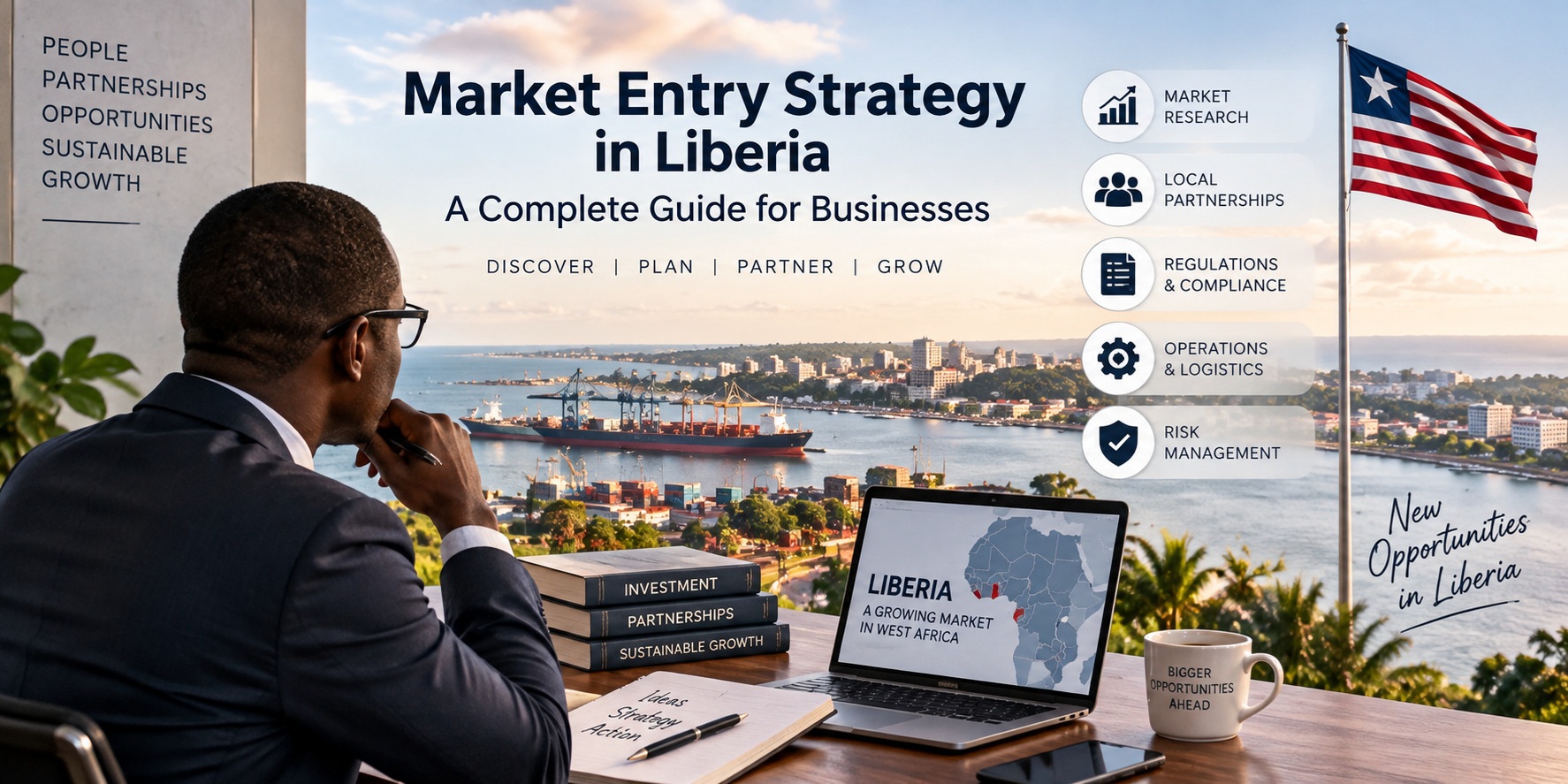
However, successful expansion is not simply about choosing a country and opening an office. A clear new market entry strategy Liberia plan helps a business understand the market, select the right entry model, manage risks and build strong local relationships.
What Is a Market Entry Strategy?
A market entry strategy is a plan that explains how a business will enter and operate in a new country.
It covers important questions such as:
- What is the demand for your product or service?
- Who are your target customers?
- Which business sectors offer opportunities?
- Who are the main competitors?
- What regulations apply to your business?
- Should you work with a local partner, agent or distributor?
- Do you need to register a local company?
- What investment and resources are required?
- How will you manage sales, logistics and operations?
For entering the Liberian market, these questions need to be considered before making a major investment. The U.S. Commercial Service also recommends thorough market research, understanding the legal and regulatory environment, developing local relationships and, where appropriate, making a field visit before entering Liberia.

Why Consider Entering the Liberian Market?
Liberia is strategically located in West Africa and presents potential opportunities that are closely connected to natural resources, infrastructure development and the rising demand for business. Opportunities were in agriculture and agro-processing, energy, infrastructure, ICT (Information Communication Technology); manufacturing; tourism; healthcare; education, logistics among other sectors. This implies that there may be global opportunities to supply products, services, technology, skills or capital into regions of high and growing demand for an international company.
However, opportunity alone is not enough. A company should first check whether its product or service fits the local market, whether the required business activity is permitted, what level of investment is needed and how the company will operate on the ground.
Step 1: Research the Liberian Market
Before investing money, businesses should understand the market they are entering. This includes researching customers, competitors, pricing, demand, suppliers, distribution channels and existing businesses in the sector.
Your research should answer questions such as:
- Who will buy your product or service?
- What problem does your business solve?
- What are customers currently using?
- What prices are common in the market?
- Who are the main local and international competitors?
- Where are your customers located?
- What distribution channels are available?
- Are there local companies that could become partners or suppliers?
Do not rely only on information found online. A local market visit, discussions with industry contacts and conversations with potential customers can provide a much clearer picture of the business environment.
Step 2: Choose the Right Sector
Current investment information from Liberia’s National Investment Commission highlights sectors including agriculture and agro-processing, energy, infrastructure, healthcare, education, manufacturing, ICT, transport, tourism and mining.
This does not mean every company in these sectors will succeed. The opportunity needs to be assessed based on:
- Market demand
- Competition
- Investment requirements
- Availability of local resources
- Government priorities
- Regulations
- Supply chain requirements
- Customer purchasing power
- Potential for long-term growth
A sector assessment can help businesses avoid entering a market simply because the sector looks attractive on paper.
Step 3: Understand Business Registration and Legal Requirements
The Liberia Business Registry acts as a one-stop shop for business registration. Businesses intending to operate in the country need to complete the relevant registration process and obtain the required registration documentation.
Depending on the type of business, companies may need to consider:
- Business structure
- Business registration
- Tax registration
- Licences and permits
- Sector-specific approvals
- Employment requirements
- Import and customs requirements
- Contracts and agreements
- Local representation
- Ongoing compliance
Foreign investors should also check whether their proposed activity has any ownership, capital or sector-specific requirements. Liberia’s investment framework has evolved, including the National Investment Act 2023, which provides the current legislative framework for investment activities. Because regulations can change and requirements differ between industries, businesses should obtain current professional and legal advice before committing to an investment.
Step 4: Select the Right Market Entry Mode
Depending on the company’s objectives, resources and sector, possible approaches can include:
Local Partner : A local partner can provide market knowledge, relationships and support with day-to-day business activities. However, businesses should conduct proper due diligence before entering into a partnership.
Agent or Distributor: An agent or distributor can be useful for companies selling products or services without immediately creating a large local operation. The U.S. Commercial Service notes that agents and distributors can play an important role in the Liberian market, particularly for companies that need local representation and distribution support.
Local Company: Some businesses may decide to establish a local company in Liberia. This can provide greater control over operations but also brings additional registration, compliance, staffing and operational responsibilities.
Joint Venture: A joint venture can allow an international company to work with a Liberian business or investor while combining resources, knowledge and market access. The right choice depends on the company’s goals, investment level, desired control, risk profile and long-term plans.
Step 5: Find and Check Local Partners
A potential partner may look suitable because they have contacts or experience, but businesses should look deeper before signing an agreement.
Consider checking:
- Company registration
- Ownership
- Previous projects
- Financial position
- Industry experience
- Reputation
- Existing relationships
- References
- Compliance history
- Ability to deliver what has been promised
Due diligence is especially important when selecting agents, distributors, suppliers, consultants or joint-venture partners. The Service recommends thorough checks on potential business partners and professional advisers. A local consultant can also help a company understand the difference between a promising introduction and a reliable long-term business relationship.
Step 6: Understand Local Institutions and Regulations
Entering Liberia means dealing with different institutions depending on the nature of your business. Businesses may need to interact with organisations involved in investment, business registration, taxation, trade, customs, sector regulation and procurement.
Tangerine Consultancy provides strategic advisory and institutional and regulatory intelligence to help organisations understand regulations, institutional processes and operating conditions in Liberia.
Step 7: Plan Logistics and Operations
A good market entry plan must also consider how the business will actually operate.
This can include:
- Import and customs procedures
- Warehousing
- Transportation
- Local suppliers
- Distribution
- Staffing
- Office or project locations
- Equipment
- Communication
- Payment processes
- Inventory management
For businesses importing products, logistics planning is particularly important. Liberia’s Freeport of Monrovia is a major entry point for imported goods, while road and transport conditions can affect movement within the country. Businesses should therefore build realistic delivery times and operational costs into their financial planning.
Step 8: Build Local Relationships
Business expansion is not only about paperwork and investment.
Strong relationships with customers, suppliers, local businesses, government institutions, industry groups and other stakeholders can help an organisation understand the market and operate more effectively. This does not mean relying on informal arrangements. It means building professional relationships based on clear communication, proper documentation and compliance. For international companies, having someone who understands the local business environment can help reduce misunderstandings and delays.
Step 9: Create a Risk Management Plan
Every international expansion comes with risks.
For a business entering Liberia, the risk assessment may cover:
- Regulatory changes
- Compliance requirements
- Partner risks
- Payment and financial risks
- Supply chain delays
- Logistics challenges
- Staffing
- Market demand
- Project delays
- Contractual risks
- Political and economic conditions
The purpose of risk planning is not to avoid every possible risk. It is to identify the important risks early and decide how they will be managed. A simple risk plan can include the risk, its possible impact, the person responsible and the action required to reduce it.
Step 10: Start With a Clear Business Plan
Before entering the market, put the research into one practical business plan.
Your plan should cover:
- Market: Who are your customers and what demand exists?
- Product or service: What are you offering and why would customers choose it?
- Competition: Who else provides similar products or services?
- Entry model: Will you use a partner, distributor, agent, joint venture or local company?
- Legal requirements: What registration, licences and approvals are needed?
- Operations: How will you deliver your products or services?
- Financial plan: How much capital will you need and when do you expect to generate revenue?
- Risk management: What could go wrong and what will you do about it?
- Local support: Which partners, advisers and institutions will you need to work with?
Common Mistakes Businesses Make When Entering Liberia
Businesses can make market entry harder by rushing the process.
Some common mistakes include:
- Entering Without Enough Research
- Choosing a Partner Too Quickly
- Ignoring Regulatory Requirements
- Underestimating Local Operations
- Treating Liberia Like Every Other Market
A strategy that worked in Europe, Asia or another African country may need to be adapted to Liberia’s own business environment.
How Tangerine Consultancy Can Support Market Entry in Liberia
For companies planning business expansion in Liberia, having practical local support can make the planning and execution process easier.
Tangerine Consultancy supports international companies, multinational contractors and organisations looking to operate in Liberia. Its services include strategic advisory, market intelligence, local facilitation, institutional and regulatory intelligence, bid and tender consultancy and project support.
Its market entry support includes:
- Market and sector assessment
- Entry strategy advisory
- Institutional landscape analysis
- Regulatory interpretation
- Risk identification and mitigation
- Stakeholder coordination
- Government and regulatory liaison
Tangerine Consultancy has more than 26 years of continuous operational experience in Liberia, giving its team long-term knowledge of local institutions, business conditions and operational realities. For companies that need support with market entry strategy consulting in Liberia, this local understanding can be useful from the early research stage through to market entry and ongoing operations.
The same support can also be valuable for companies starting a business in Liberia or organisations looking for startup consulting in Liberia before committing significant resources.
Summary
A new market entry strategy in Liberia should be more than registering a company and marketing your business. Companies must understand the market and choose the right sector and customer demand; they must spend time on regulations, entry model choice, partner due diligence, or logistics and operations planning.
Local knowledge also matters. A company entering Liberia from another country may understand its own product or service very well but still need help understanding the local market and institutional environment. With proper research, realistic financial planning, strong local relationships and the right professional support, businesses can approach entering the Liberian market with a much clearer plan.
For organisations considering expansion into Liberia, Tangerine Consultancy provides local strategic advisory, market entry support, institutional intelligence and practical project support backed by more than 26 years of experience in Liberia.
Frequently Asked Questions
What is a new market entry strategy in Liberia?
A new market entry strategy in Liberia is a structured plan for entering and operating in the Liberian market. It normally covers market research, sector selection, business registration, regulations, local partnerships, operations, investment requirements and risk management.
Is Liberia suitable for business expansion?
Liberia has investment opportunities across sectors such as agriculture, agro-processing, energy, infrastructure, ICT, healthcare, manufacturing, tourism and logistics. However, suitability depends on the company’s sector, target customers, investment capacity and business model.
Do foreign companies need local support when entering Liberia?
Local support enables international companies to understand the business environment, identify relevant stakeholders, and evaluate potential partners as well as maneuver institutional and regulatory processes. Depending on the sector and entry model, this is ultimately the range of support that you should look for.
What should I check before entering the Liberian market?
Businesses should research market demand, competition, regulations, registration requirements, investment needs, potential partners, logistics, taxation, staffing and operational risks before entering the market.
How can Tangerine Consultancy help with market entry in Liberia?
Tangerine Consultancy provides market entry advisory, sector assessment, institutional and regulatory intelligence, local facilitation and strategic decision support for organisations entering or operating in Liberia. The company also supports clients through project execution and other business activities in the country.